
Linear Search Pseudocode O level Computer Science 2210:
Table of Contents
In the Cambridge O Level Computer Science (2210) syllabus, mastering algorithms is essential for success in Paper 2. One of the most fundamental searching techniques you must understand is the Linear Search. This algorithm is the foundation for data retrieval and serves as a building block for more complex programming tasks.
The Logic: What is a Linear Search?
A linear search is a sequential method for finding a specific value within a list or array. The process is straightforward: the algorithm starts at the first element of the array and compares it with the target value. If no match is found, it moves to the second element, continuing this process one by one until either a match is found or the end of the list is reached.
In terms of algorithmic efficiency, linear search has a time complexity of $O(n)$. This means that in the worst-case scenario—where the item is at the final position or not present at all—the computer must perform $n$ comparisons, where $n$ is the total number of elements in the array.
The Standard 2210 Pseudocode Implementation
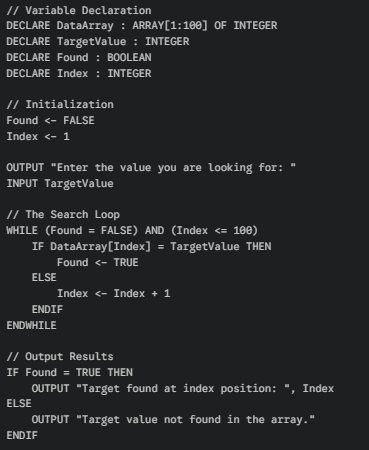
When writing pseudocode for the 2210 exam, it is vital to use the standard CAIE keywords. Below is a robust implementation of a linear search designed to find a specific value within an array of 100 integers.
Detailed Algorithm Breakdown
- The Flag (
Found): This Boolean variable tracks the state of the search. Initializing it toFALSEensures the loop starts correctly. - The Pointer (
Index): This variable tracks the current position being checked. It must start at the first index (usually1in 2210 pseudocode). - The
WHILELoop: This is the most efficient loop choice. Unlike aFORloop, which may iterate through the entire array regardless of success, aWHILEloop can terminate the moment the item is found, saving unnecessary processing cycles. - The Dual Exit Condition: The loop must check both whether the item is found AND whether there are still elements left to check (
Index <= 100). This prevents “Index Out of Bounds” errors.
Comparing Linear Search vs. Binary Search
Cambridge Paper 2 frequently asks students to compare searching algorithms. Use the following points for your revision:
- Linear Search: Works on unsorted and sorted lists. It is simple to implement but becomes inefficient as the dataset grows.
- Binary Search: Requires a sorted list. It is much faster for large datasets because it halves the search area with each step, but it is more complex to write.
Common Pitfalls in Paper 2
To ensure maximum marks in the exam, avoid these common mistakes:
- Infinite Loops: Forgetting the
Index <- Index + 1statement will cause the algorithm to check the first element repeatedly. - Incorrect Initialization: Always set your
Foundflag andIndexpointer before the loop begins. - Boundary Errors: Ensure your loop condition matches the array size exactly (e.g., if the array is size 100, use
Index <= 100).
GeekMatrex Verdict
The linear search pseudocode O Level computer science 2210 is a mandatory skill for any student aiming for an A*. It teaches the core principles of iteration and selection that are used across all programming languages, from Python to C++.
Some other GEEKMATREX Guides:
The Ring 0 Conflict: Kernel-Level Anti-Cheat Explained (and Why Your PC Crashes)
Is Process Lasso Safe? The Truth About Bans, Viruses, and System Stability (2026 Review)
Stop Using Game Boosters: Why Process Lasso is the Only Tool You Need (2026 Guide)
Stop Your Phone Overheating: The Technical Guide to Fixing Android AI Battery Drain Fix (2026)
Stop CPU Core Parking: How to Unlock Ultimate Performance Windows 11 (Free Tool)
Intel vs AMD in 2026: Which CPU Is Better for Gaming, Work, and Budget Builds?
Android Optimization in 2026: Make Any Phone Faster, Smoother, and More Battery-Friendly
How to Remove Bloatware Safely on Android (No Root) — 2026 Step‑By‑Step Guide