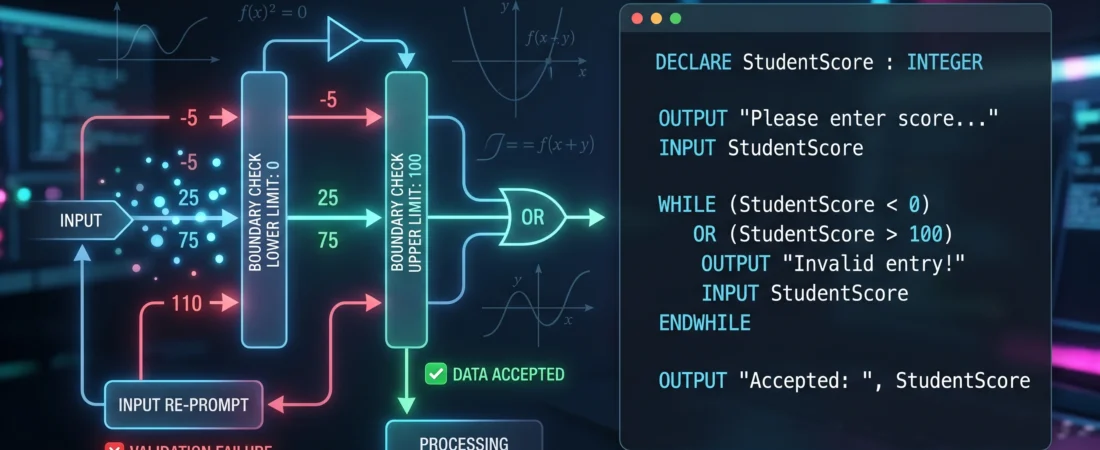
Range check validation pseudocode o level computer science 2210:
Table of Contents
When designing robust algorithms for the Cambridge O Level Computer Science (2210) Paper 2 exam, handling user input safely is a major requirement. Computers rely on clean data to function correctly. If a user inputs data that falls outside of expected parameters, it can cause runtime errors or faulty outputs.
To prevent this, computer scientists use Data Validation. One of the most frequently assessed validation methods in the 2210 syllabus is the Range Check. This technical guide breaks down the structural rules, logical operators, and exam-compliant pseudocode required to implement a range check effectively.
The Core Logic: What is a Range Check?
A range check is an automated digital boundary check. It verifies whether a numerical value or data input falls entirely within a specified upper limit and a lower limit (inclusive of those boundaries).
Common real-world examples in examination questions include:
- Checking if an exam percentage is between
0and100. - Verifying if a month entry falls between
1and12. - Confirming if a student’s age matches a specific school range (e.g.,
11to16).
Validation vs. Verification
It is vital not to confuse these two terms on the exam. Validation is the automatic checking of data by a program to ensure it is reasonable and meets specific criteria before processing. Verification is a check to ensure data matches its original source exactly (such as double-entry or visual checks).
The Standard 2210 Pseudocode Implementation
In the CAIE 2210 syllabus, input validation is handled dynamically using a post-assertion pattern. This means the program accepts an input, tests it against the boundaries, and uses a conditional loop to trap the user until they provide a reasonable, compliant value.
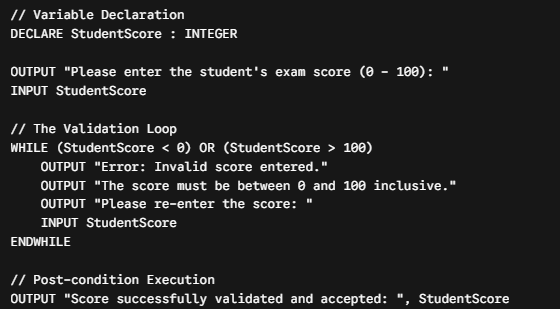
Below is the standard, exam-compliant pseudocode for a range check that restricts an input value to an exam score between 0 and 100 inclusive:
Detailed Structural Breakdown
- The Pre-Check Input: The code requests an initial value before entering the loop. This ensures the loop condition has data to evaluate on its first pass.
- The
ORLogical Operator: This is a critical logic point. The loop must trigger if the value is too low OR if the value is too high. Using anANDoperator here is a classic logic failure, as a single number can never be less than 0 and greater than 100 simultaneously. - The Trap Mechanics: The
WHILEloop acts as an automated filter. If the input is invalid, the code inside the block executes, displaying an error message and prompting for a new input. - The Exit Condition: The loop only terminates when the condition evaluates to
FALSE—which means the input successfully satisfies both boundaries simultaneously.
Alternative Structure: The REPEAT...UNTIL Loop
The 2210 syllabus also permits the use of post-conditional loops. Here is the exact same range check logic written with a REPEAT...UNTIL construct:
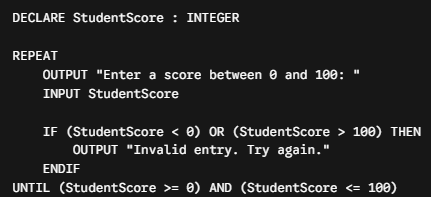
Note the Logic Flip: A
WHILEloop runs while the data is invalid (usingOR). AREPEAT...UNTILloop runs until the data becomes valid (usingAND).
For comprehensive guidelines on structured loops, conditions, and algorithm flow patterns, review the educational programming standards hosted on W3Schools Computer Science Core Logic.
Common Examination Errors to Avoid
When answering Paper 2 algorithm questions, look out for these frequent mistakes:
- Wrong Boundary Relational Operators: Pay close attention to whether the limits are inclusive or exclusive. If a question states a range is between 1 and 10 inclusive, using
StudentScore < 1is correct. WritingStudentScore <= 1would incorrectly reject the number 1. - Forgetting the Internal
INPUTStatement: If you do not include a freshINPUTline inside the validation loop, the program will never get a new value to check. This results in an infinite loop that locks up system memory. - Incorrect Logical Operators: Substituting
ORforANDinside aWHILEvalidation statement makes the expression logically impossible to satisfy, causing the validation check to be completely skipped.
To cross-verify your terminology and ensure your pseudo-syntax perfectly aligns with Cambridge grading scales, read through the official Cambridge University Press Computer Science Resource Hub.
Summary
Mastering range check validation pseudocode o level computer science 2210 structures ensures your programs reject corrupted or anomalous data at the system boundary. Memorizing the structural layout of validation traps helps you secure full marks on input-handling tasks in your upcoming Paper 2 exam.
What is the difference between a range check and a limit check?
A range check verifies that a value falls within two distinct boundaries: a minimum (lower) limit and a maximum (upper) limit (e.g., checking if a month is between 1 and 12). A limit check, on the other hand, only tests for a single boundary. It can check either a minimum limit or a maximum limit, but not both at the same time (e.g., checking if an age is $\ge 18$).
Why does the WHILE loop use OR instead of AND for validation?
The validation loop is designed to run while the data is invalid. For an input value to be invalid in a range check, it only needs to fail one of the boundaries.
For example, if the valid range is 0 to 100, a score of 105 makes the expression (Score < 0) OR (Score > 100) true because 105 is greater than 100. If you used AND, the computer would check if 105 is less than 0 and greater than 100 at the same time. Since no number can do both, the condition would evaluate to false, and the invalid data would bypass your validation completely.
Can a range check be used on data types other than integers?
Yes. A range check can be used on any data type that has a natural, sequential order:
REAL (Decimals): Checking if a temperature reading is between 35.0 and 42.5.
CHAR (Characters): Checking if a single character input falls within the alphabetic range of A to Z.
STRING: Checking if a text entry is alphabetically between two boundary words, though this is less common in the 2210 syllabus.
How does a range check differ from a length check?
A range check tests the actual value of the data that has been entered (e.g., is the number between 1 and 100?). A length check tests the number of characters contained within the input string (e.g., ensuring a password contains at least 8 characters, or that a telephone number is exactly 11 digits long).
Where should a range check occur in a program structure?
A range check must always occur immediately after data is input and before any processing takes place. Checking the data at the system boundary prevents invalid information from being used in downstream calculations, which would otherwise lead to runtime crashes or logical errors (often referred to as the Garbage In, Garbage Out principle).
Some other GEEKMATREX Guides:
Linear Search Pseudocode O Level Computer Science 2210: A Complete Student Guide
Binary Search Pseudocode O Level Computer Science 2210: A Complete Technical Guide